There is a version of farmhouse style that I love and a version that makes me a little tired. You know the second one. Grey everything, a wooden sign that says Gather, a barn door on a bathroom, and about forty mason jars.
The first version is warmer than that. Older. It looks like the house has been collecting things for thirty years instead of one shopping trip.
That is what I have been chasing in my own place since 2021, and after a lot of trial and a fair amount of return shipping, here is what actually gets you there.
Where the look really comes from
The thing nobody tells you is that farmhouse is not a color scheme. It is a texture story. Old wood, worn metal, thick woven fabric, plaster or paint with a little softness, and lighting that is warm rather than bright. If you get those four textures into a room, it reads farmhouse even if you never hang a single piece of decor.
And here is the mistake I made early. I bought a whole matching collection in one weekend, all from the same store, all brand new. The room looked staged and hollow, and it took me a year to understand why. Real farmhouses were assembled slowly by people who kept what worked, and rooms only feel that way if you build them the same messy, gradual way.
1. Pick your wood tone before anything else
Everything else hangs off this decision. Choose one primary wood tone, something warm like white oak or a mid brown pine, and let the rest of the room’s wood sit within two shades of it. Mixing five random tones is the fastest way to make a room feel like a furniture clearance floor.
2. Use a warm white, never a cool one
Cool greys and blue whites are what dated the 2016 version of this style so badly. Go for a white with a drop of yellow or beige in it, and paint a big sample board rather than a small patch on the wall. Look at it at 8am and again at 6pm before you commit.
3. Do shiplap on one surface only
I like shiplap. I do not like a house where four walls in every room have it. Put it on one feature wall or, better, on the ceiling of a small room like an entry or powder bath. Ceiling shiplap is underrated and it makes the room feel taller, oddly enough.
4. Install an apron front sink if you touch the kitchen
The single most farmhouse thing you can add without redoing the room. Fireclay holds up better than cast iron in my experience, and a thirty inch sink is plenty for most families. Just know the cabinet under it usually has to be modified, so factor that into the quote.
5. Keep open shelving away from the stove
Two open shelves look beautiful in photos. Two open shelves next to a gas burner collect a greasy film that no amount of wiping fully removes, and I found that out the hard way. Put them on the wall near the sink or coffee area instead, and only stack what you use weekly.
6. Use butcher block on the island, not everywhere
Wood counters are warm and lovely and also a lot of upkeep. Run stone or quartz on the working perimeter and let the island be the wooden piece. Oil it every couple of months with food safe mineral oil and it will look better every year.
7. Paint the interior doors a dark color
Cheapest transformation in this whole list. Two coats of a soft black or a deep charcoal on flat panel doors, with the trim left warm white, and suddenly the whole hallway has bones. Use a cabinet enamel, not a wall paint, so it does not scuff.
8. Be honest about barn doors
They look great over a pantry or a laundry opening. They are terrible on bathrooms, because they do not seal and everyone in the house can hear everything. My honest advice is one barn door per home, maximum, and put it somewhere it actually solves a swing clearance problem.
9. Anchor every room with one genuinely old thing
This is the trick that changed my house. A real antique dough bowl, an old ladder, a chippy painted stool from an estate sale. Something with actual wear on it. I noticed that the rooms people always comment on are the ones with a piece that nobody could buy new.
10. Mix aged brass and matte black on purpose
Matching every metal in the house is a builder habit, not a farmhouse one. Pick two, usually a warm aged brass and a soft black, and repeat each of them at least three times in a room. It looks collected instead of accidental.
11. Choose faux beams if the ceiling allows it
Real reclaimed beams are wonderful and heavy and expensive. Hollow box beams made from stained pine boards weigh almost nothing, install with a cleat, and read exactly the same from six feet below. Run them the short direction of the room so the ceiling looks wider.
12. Hang schoolhouse or gooseneck lighting
Milk glass schoolhouse fixtures over a hallway, gooseneck barn lights over a sink or outside the door. Warm bulbs, always, somewhere around 2700K. And skip the matching three piece lighting bundle, since buying your fixtures separately is what stops the room looking like a catalog page.
13. Build the dining table setup with a bench
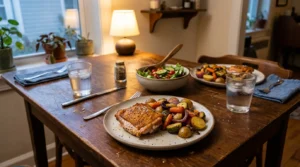
A long wooden table, two or three chairs on one side, and a bench on the other. The bench does more than seat people, it breaks the symmetry and makes the whole setup feel casual. Mismatched chair styles in one shared finish work beautifully too.
14. Go slipcovered on the sofa
Washable, relaxed, and it gets better as it wrinkles. Linen or a heavy cotton in oatmeal or soft white, and buy a spare cover if the maker offers one. A crisp tight upholstered sofa fights the whole style, and a slightly rumpled one belongs.
15. Layer in ticking stripe, grain sack, and check
Three patterns that do almost all the heavy lifting. A grain sack stripe pillow, a small buffalo check on a throw, a ticking stripe on a chair cushion. Keep them in the same two colors so it reads calm rather than busy.
16. Put a jute or wool rug under everything
Jute for texture, wool for softness underfoot, and honestly a jute base layer with a smaller wool rug on top is my favorite combination. Vacuum jute weekly because it sheds for the first month, then it settles down and lasts years.
17. Give the entry a bench, hooks, and a basket
Even if you do not have a real mudroom. A simple wooden bench, five sturdy hooks mounted at forty eight inches so kids can reach, and one big basket underneath for shoes. Function is the point of this style, so the entry should actually work.
18. Keep floors wide plank and matte
Narrow glossy strips fight the look. Seven inch or wider planks in a matte or satin finish hide dust better and feel older. If you cannot replace flooring, a large low pile rug in the main path does most of the same work.
19. Do something with the porch
Two rocking chairs or a swing, a pair of oversized planters flanking the door, and a gooseneck light above it. Fill the planters with one tall thing, one mounding thing, and one thing that spills over the edge. Porches sell the whole house from the curb.
20. Skip the word signs
Strong opinion, but I stand by it. One sign in a home can be charming, five is a theme park. Put a real herb pot, a stack of old books, or a bowl of lemons where the sign was going and the room will feel twenty years older instantly.
How to layer it without buying everything at once
Start with paint and lighting, because those two set the temperature of every other decision and they are the cheapest to change later. Then handle the big furniture, one piece at a time, buying the sofa and the table first since you use them daily. After that, go hunting. Estate sales on Sunday afternoons are half price at most of them, and thrift stores near older neighborhoods are far better than the ones near new developments. Give yourself a rule of one new piece per month, which sounds slow but keeps you from ending up with the matching collection problem I had. And leave gaps. A shelf that is not fully styled, a wall that stays bare for a season, a corner with nothing in it yet. Farmhouse rooms breathe, and the empty spots are what make the good pieces stand out when you finally find them.
Frequently asked questions
Is farmhouse style still popular? The cool grey version has faded, but the warm version with real wood tones, cream walls, and vintage pieces is very much alive. Most people call it modern farmhouse or English cottage now, and it leans warmer and less grey than it did a decade ago.
What is the difference between farmhouse and modern farmhouse? Traditional farmhouse leans older and more layered, with patina, mismatched pieces, and a lived in feel. Modern farmhouse keeps the wood and white palette but uses cleaner lines, more black metal, and fewer antiques.
How do I get the look on a small budget? Paint, lighting, and thrifted wood pieces. A warm white wall color, two secondhand lamps with warm bulbs, and one old wooden bowl or crate will do more than a cart full of new decor. Buy slowly and secondhand where you can.
Do I need shiplap for a farmhouse look? No. Shiplap is one texture option among many, and beadboard, board and batten, or even a limewashed wall gets you similar warmth. If you do use it, one surface per room is plenty.
What colors work best for farmhouse rooms? Warm whites and creams as the base, with soft black, aged brass, and natural wood as accents. Muted greens, dusty blues, and clay tones work well for a bit of color without breaking the calm.
Final thoughts
The homes I love most in this style all have one thing in common, and it is not a single product. They look like somebody actually lives there and has for a while. Scuffed table legs, a bowl that gets used, a plant that is slightly overgrown.
So take your time with it. Paint one room, find one old thing you love, and let the rest come as you find it. If you turn up something great at an estate sale, come back and tell me what it was, because that is genuinely my favorite part of all this.