The first apartment is a strange upgrade. You go from a room with a bed bolted to the wall to a whole place with a kitchen, a living room, and absolutely nothing in it. No furniture, no pots, no shower curtain, and a lease with your name on it.
It is exciting for about four hours. Then it is overwhelming.
I have done this three times, once badly and twice well, and helped a couple of younger cousins do it since. So here is the practical version, what to buy, in what order, and the systems that stop a shared apartment from falling apart in November.
Where to put your energy first
Almost nobody gets this wrong on purpose, but a lot of people spend their whole budget on the living room because that is the room in the photos, then sleep on a terrible mattress for nine months. Flip that. The rooms you use when nobody is watching matter more than the room people see.
And do the boring stuff on day one, before you unpack anything. Photograph every scratch, stain, burn, and broken blind, timestamp included, and email the whole set to your landlord and yourself. It takes twenty minutes. I skipped it once and lost three hundred dollars over a carpet stain that was already there when I moved in, and I had nothing to prove it.
1. Buy in the right order, not all at once
Mattress first, then a real desk chair, then the couch, then the dining table, then anything decorative. That order sounds unromantic and it is exactly right, because you will spend roughly a third of your life on the mattress and another big chunk in the chair. Give yourself permission to have a nearly empty living room for the first month. Nobody who visits actually cares, and you will make much better choices once you know how the place is used.
2. Measure the stairwell before you buy the couch
Not the room. The stairwell, the doorway, and the turn at the top of the landing. Student apartments are famous for tight old staircases, and a seventy two inch sofa that unscrews its legs will make it where a ninety inch sectional never will. My rule now is nothing longer than the shortest hallway measurement plus six inches, and I have not been stuck on a landing since.
3. Go secondhand for the big stuff, new for the soft stuff
Marketplace and estate sales in the last two weeks of the semester are full of solid furniture for almost nothing, because graduating seniors just want it gone. Buy the couch frame, the bookcase, the desk, and the coffee table used. Then buy the mattress, pillows, and towels new, since those are the things where somebody else’s history genuinely matters. Check any used upholstered piece carefully in daylight before it comes inside, seams and corners especially.
4. Fix the lighting immediately
The light in most student apartments is genuinely bad. One harsh ceiling fixture, cool white bulbs, and shadows everywhere by six pm. Buy three lamps for the shared space and one per bedroom, put warm bulbs in all of them at around 2700K, and mostly leave the overhead off. This is a forty dollar change that makes the apartment feel twice as expensive, and it is the tip my friends have thanked me for most.
5. Put a big rug down for the neighbors, not just for you
If you are above someone, this is not optional. Hard floors in old buildings carry every footstep, and noise complaints are how a good year turns stressful. A large low pile rug with a cheap felt pad underneath cuts the transfer a lot, warms up the room, and hides whatever the floor is doing. Get the biggest one your budget allows and put the front legs of the seating on it.
6. Build a kitchen with twelve things, not sixty
You need a chef knife, a cutting board, one ten inch nonstick skillet, one medium pot, a sheet pan, a colander, a spatula, a wooden spoon, tongs, a can opener, a set of mixing bowls, and four of each plate, bowl, glass, and fork. That is genuinely it for the first year. Add things only when you actually hit the moment you need them, because unused kitchen gear is the number one thing I see filling up student cabinets.
7. Make the dining table the real center of the apartment
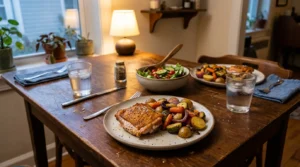
Most college apartments have no room for both a study desk and a proper dining setup, so let the table do both jobs. A basic four seat table with a lamp nearby handles group projects, dinner, and someone’s laptop at 2am. Keep a small basket on it for the stuff that piles up and clear it every Sunday. It sounds fussy but a permanently cluttered table quietly stops being usable.
8. Set up the shared storage before the first grocery run
Assign fridge shelves and cabinet sections in the first week, while everyone is still being polite about it. Top shelf and left cabinet for one person, and so on, plus one shared shelf for communal things like milk and condiments. Label them if you have to. Every roommate fight I have witnessed started as a small food or space thing that nobody wanted to bring up in September and everybody was furious about by December.
9. Give the entryway a job
Hooks, a shoe tray, and a bowl or small dish for keys, mounted or placed within two steps of the door. Apartments with four people generate an unbelievable amount of shoes and bags, and a designated spot is the difference between a hallway and an obstacle course. A cheap over the door hook rack costs about twelve dollars and does most of the work.
10. Decorate the walls without losing your deposit
Use good adhesive strips rated well above the item weight, clean the spot with rubbing alcohol first, press for a full thirty seconds, and remove by pulling the tab straight down. Lean larger art on a console or the floor instead of hanging it. Removable wallpaper works on one wall in most rentals, but test a strip in a corner for a week, since old landlord paint sometimes lifts right off with it.
11. Keep your bedroom out of the shared chaos
Your room is the only door you can close, so protect it. Do not let it become storage for suitcases, sports gear, and everybody’s overflow. Bed, a lamp, one comfortable spot to sit, blackout curtains if you live on a street with any nightlife. I noticed that the people who kept their bedrooms calm were the ones who still liked their roommates in April.
12. Write down the money stuff in the first week
Who pays which bill, how the internet gets split, what happens if someone moves out early, who owns the couch when the lease ends. A shared note on your phones is enough, it does not need to be a contract. And buy shared items in a way that has an obvious owner, so nobody is arguing over a vacuum cleaner in May while the moving truck waits outside.
How to actually spend your budget
If you have around eight hundred dollars for a bedroom plus your share of the common space, here is roughly how I would split it. Three hundred on a mattress and a topper, because it is the one thing that affects every single day. A hundred and fifty on lamps, bulbs, and a curtain rod with blackout panels for your room. Two hundred on a rug for the shared space, split between roommates so your share is smaller. Then the rest on kitchen basics and whatever chair or desk situation you need for studying. Buy the furniture secondhand and put the savings into the mattress, seriously. And leave a hundred dollars unspent for the first month, because something always comes up, usually a shower curtain rod, a plunger, and the discovery that your apartment has exactly one outlet in a useful position. Give the place a full month before buying decor. You will know what you actually need by then, and you will buy far less of it.
Frequently asked questions
What should I buy first for a college apartment? A good mattress, a desk chair, and lighting. Those three affect your sleep, your studying, and how the place feels at night. Furniture for the living room can wait a few weeks and is usually cheaper secondhand anyway.
How much does it cost to furnish a college apartment? Most students land somewhere between eight hundred and two thousand dollars for a bedroom plus their share of common areas. Buying big furniture used and splitting the shared items with roommates is what pulls that number toward the low end.
How do I decorate a college apartment without losing my deposit? Use quality adhesive strips rated above the item weight, lean art rather than hanging it, and test removable wallpaper on a small hidden patch first. Also photograph all existing damage on move in day and email it to your landlord.
What kitchen items do I actually need? A chef knife, a cutting board, one skillet, one pot, a sheet pan, a colander, basic utensils, and four place settings. That covers almost everything a student cooks in the first year, and you can add specialty gear later.
How do I avoid roommate conflict in a shared apartment? Sort out fridge space, cleaning, and bill splitting in the first week while everyone is still easygoing about it. Most conflicts come from small unspoken things that build up quietly rather than from one big disagreement.
Final thoughts
Your first apartment is going to have something wrong with it. A door that sticks, a landlord who takes six days to answer, a neighbor who plays bass at midnight. That is part of the deal, and honestly it becomes the stuff you tell stories about later.
So take the setup slowly. Get the boring things right in week one, buy the mattress you deserve, and let the rest of the apartment fill in over the semester. If you are moving into your first place this year, I would love to hear what you ended up buying first and whether it was the right call.